Most advice on an influencer marketing campaign starts in the wrong place. It says to find creators first, then work out the rest later.
That’s backwards.
If you start with a list of influencers, you usually end up buying content, collecting screenshots, and arguing internally about whether any of it moved revenue. The campaigns that scale don’t begin with discovery. They begin with measurement design, a clear operating model, and a system that ties creator activity to business outcomes.
The channel isn’t fuzzy by nature. Teams often set it up in a fuzzy way. A 2025 UK Influencer Marketing Benchmark Report cited by BCG found that 68% of UK restaurants and ecommerce brands struggle with precise attribution, and only 22% use UTM links or promo codes effectively, which leads to 40% underreported revenue from campaigns. That isn’t proof that influencer marketing can’t be measured. It’s proof that many brands still launch without proper infrastructure.
The practical shift is simple. Stop treating influencer as a one-off social tactic. Run it like a repeatable growth channel.
Building Your Campaign Blueprint Beyond Vanity Metrics
If likes are your main success metric, your influencer marketing campaign is already drifting off course.
Likes can signal creative fit. They can indicate audience resonance. They can even help you spot promising creators. But they don’t tell a restaurant whether bookings increased, an ecommerce team whether a creator drove checkouts, or an agency whether a client should renew budget.

Define the business event first
A campaign blueprint starts with one question. What business event are we trying to cause?
That answer changes everything downstream.
For restaurants: A booked table, redeemed offer, walk-in mention, or review.
For ecommerce: A product page visit, add-to-basket, purchase, or repeat purchase trend.
For agencies: A qualified lead, booked discovery call, or trackable client result.
For multi-location brands: Store-level visits, local code usage, or location-specific demand signals.
Once that event is defined, the campaign stops being abstract. You can build the workflow around evidence instead of hope.
Map creator activity to revenue paths
A strong plan connects each creator output to a measurable action. That usually means assigning:
A unique promo code for direct redemption tracking.
A UTM-tagged link for click and session tracking.
A landing destination matched to the content angle.
A reporting owner who reviews performance during the live period, not weeks later.
Often, teams become lazy. They brief the creator, approve the content, and only think about attribution after the post is live. By then, recoverable data is already gone.
Practical rule: If a creator can publish without a unique code, a unique link, and a defined conversion event, the campaign isn’t ready.
A good KPI framework also distinguishes between leading indicators and commercial outcomes. Saves, comments, watch-through, story taps, and link clicks help you diagnose creative quality. Revenue, bookings, lead submissions, and redemptions tell you whether the programme deserves more budget.
If you need a useful model for setting targets that connect content performance to growth, this guide on influencer KPIs that drive growth is worth reviewing before you write a brief.
Build around channels and buying behaviour
Different platforms create different paths to action. That sounds obvious, but teams still copy the same brief across TikTok, Instagram, and Facebook and expect equivalent outcomes.
A practical blueprint asks:
Campaign variable | What to decide before launch | Why it matters |
|---|---|---|
Platform | Instagram, TikTok, Facebook, or a mix | The content format changes how people discover and act |
Offer type | Discount, perk, launch access, menu feature, bundle | The wrong offer can suppress conversion even if engagement looks healthy |
Local relevance | National message or location-specific hook | Local campaigns usually need local proof points |
Landing path | Homepage, product page, booking page, or form | Extra clicks reduce attribution clarity |
Reuse rights | Organic only or paid/social reuse | Top-performing creator assets often outlive the initial post |
If Facebook is part of your channel mix, it helps to study actual content styles that suit that platform rather than repurposing short-form creative blindly. This overview of Facebook influencers marketing is useful for understanding how creator-led campaigns behave differently there.
Plan for decision-making, not just reporting
Most dashboards are built to summarise. Good campaign systems are built to support decisions.
Before launch, set rules for what happens if:
one creator drives strong clicks but weak conversions
a creator produces excellent UGC but limited reach
a location underperforms despite healthy engagement
one format clearly outperforms another
code redemptions appear, but link traffic is low
Those situations happen constantly. Teams that scale don’t panic when they see them. They already know what actions they’ll take.
The cleanest campaigns aren’t the ones with the prettiest reporting. They’re the ones where everyone knows what counts as success before the first outreach message goes out.
A blueprint built this way does something most influencer guides ignore. It turns campaign planning into a commercial discipline. Once that’s in place, creator sourcing gets easier, because you know exactly what kind of partner you need.
Sourcing and Vetting Creators for Authentic Performance
The slowest part of an influencer marketing campaign is rarely outreach. It is bad sourcing disguised as progress.
Hours disappear into scrolling, shortlisting, and debating creators who were never a fit in the first place. Manual sourcing tends to reward what is easiest to spot on a profile. Follower count, polished visuals, and visible engagement get overweighted. Buyer relevance, commercial intent, and content consistency get missed.
That is how teams build creator lists instead of a creator system.
Stop sorting by audience size
Follower count helps define campaign role, budget range, and expected reach. It does not tell you whether a creator can drive action.
Use creator tiers to structure testing and spend allocation, not to decide quality upfront.
Creator Tier | Follower Range | Best For | Typical Engagement | Cost |
|---|---|---|---|---|
Nano | Under 10k | Hyper-local campaigns, early product seeding, trust-heavy recommendations | Often strongest relative engagement in niche audiences | Usually lower-cost or product-led arrangements |
Micro | 10k to 50k | Conversion-focused campaigns, community credibility, repeat collaborations | Typically strong and consistent for niche offers | Usually moderate and scalable |
Macro | Above micro tiers | Broad awareness, larger campaign moments, reach expansion | Often lower relative engagement than smaller creators | Usually higher and less flexible |
Those ranges matter less than role clarity. A nano creator can outperform a larger account if the campaign needs local trust, credible product usage, or repeatable UGC. A macro creator can still earn a place if the goal is reach expansion and the economics work.
The key question is tighter than many assume. Does this creator influence the exact buyer you need to move?
Vet audience fit before content style
Pretty feeds create false confidence. I have seen average-looking creators outperform polished lifestyle accounts because their audience matched the offer, the price point, and the buying context.
A useful vetting process checks five areas:
Audience overlap: Does the audience map to your target customer by age, location, interests, and likely buying power?
Category credibility: Has the creator posted about adjacent products, habits, or venues in a way that feels natural?
Commercial posture: Can they recommend products without sounding like every post is an ad?
Location relevance: For retail, hospitality, fitness, and events, are enough followers close enough to act?
Response quality: Do comments show real familiarity, specific questions, and proof that people take recommendations seriously?
This step decides whether you are buying attention or buying influence. They are not the same thing.
Make authenticity checks a core requirement
Weak vetting wastes budget. You pay for reach, then discover the audience is inflated, geographically useless, or conditioned to ignore sponsored posts. Analysts at Dash noted in their influencer marketing statistics that fake engagement remains a real issue and that stronger measurement and testing improve campaign effectiveness. That is enough reason to treat vetting as a performance discipline, not admin.
Check for signals like these:
Comment quality
Generic bursts such as "love this" and emoji chains can be fine in small doses. A comment section full of them usually is not. Real audiences ask practical questions, mention details from the post, and interact unevenly.View-to-engagement consistency
Look for patterns across multiple posts. One viral video or one underperformer tells you very little on its own.Brand history
If every other post is sponsored, conversion strength often drops. Audiences notice when recommendation density gets too high.Audience geography
This matters a lot for city-based campaigns. A restaurant in Manchester does not need broad UK visibility from a creator whose strongest audience cluster is overseas.Content originality
Trend participation is normal. Recycled scripts, identical hooks, and interchangeable product endorsements are warning signs.
A creator can be genuine and still be a poor commercial fit. Authenticity and relevance are separate checks.
Build a sourcing engine, not a one-off list
Campaigns get expensive when every launch starts from zero. The better model is a live creator pipeline with structured notes on audience fit, response speed, content quality, previous results, usage rights, and rate expectations.
That pipeline should include clear buckets:
Ready now: pre-vetted and suitable for immediate campaigns
Monitor: promising fit, but not tested yet
Seasonal: useful for launches, holidays, or regional demand spikes
UGC-first: stronger at making converting assets than driving reach
Scale candidates: creators worth retesting across offers, regions, or paid amplification
The repeatable system comes into play. Instead of rebuilding the list every quarter, the team updates status, adds evidence, and improves selection quality over time.
If the campaign depends heavily on video, keep a shared reference library so creators, marketers, and reviewers are calibrating against the same standard. These top performing video examples for 2026 are useful for comparing testimonial-style UGC with more polished, ad-like execution.
Use tools to narrow the pool, then apply judgement
The fastest workflow is hybrid. Use software and filters to surface creators by niche, location, engagement patterns, posting frequency, and platform fit. Then review them manually with the campaign brief in hand.
For Instagram-led campaigns, an Instagram engagement calculator for comparing creator engagement rates helps standardise one part of the screen. It will not tell you whether the audience can buy, visit, or convert. A human review still has to answer that.
One more habit saves a lot of wasted time. Record why a creator was rejected.
That note might be "wrong geography", "high sponsorship density", "good UGC but weak comments", or "audience too broad for this offer". Six months later, that history stops the team from recycling poor candidates and makes sourcing faster with each campaign.
The best creator roster is usually the one with the clearest selection logic. That is what turns sourcing from a manual task into a scalable input for ROI.
Mastering Outreach and Briefing for Content That Converts
A lot of outreach fails before the creator even opens the message. The brand leads with itself, sends a generic pitch, and asks for availability without giving enough context to make the opportunity interesting.
Creators can spot a mass send immediately. So can managers.
Write outreach that respects how creators evaluate offers
Good outreach does three jobs quickly. It proves relevance, explains the campaign in plain language, and makes the next step easy.
The opening should answer three unspoken creator questions:
Why are you contacting me specifically?
What are you asking me to create?
Is this campaign organised enough to be worth my time?
If your message doesn’t answer those, reply rates drop and negotiation gets messy.
A simple outreach structure works well:
Specific reason for selection
Mention a real content angle, audience trait, or local relevance.Clear campaign summary
State the product, venue, offer, or objective without a bloated brand intro.Practical campaign details
Share platform, expected deliverables, timing, and whether tracking links or codes are included.Easy response path
Ask if they’re interested and available. Don’t force a long form at first touch unless the campaign volume requires it.
If you want examples that balance personalisation with speed, this guide on how to write the perfect influencer outreach email is a strong reference.
The brief should guide, not suffocate
Once a creator agrees in principle, the brief becomes the difference between smooth execution and endless revision.
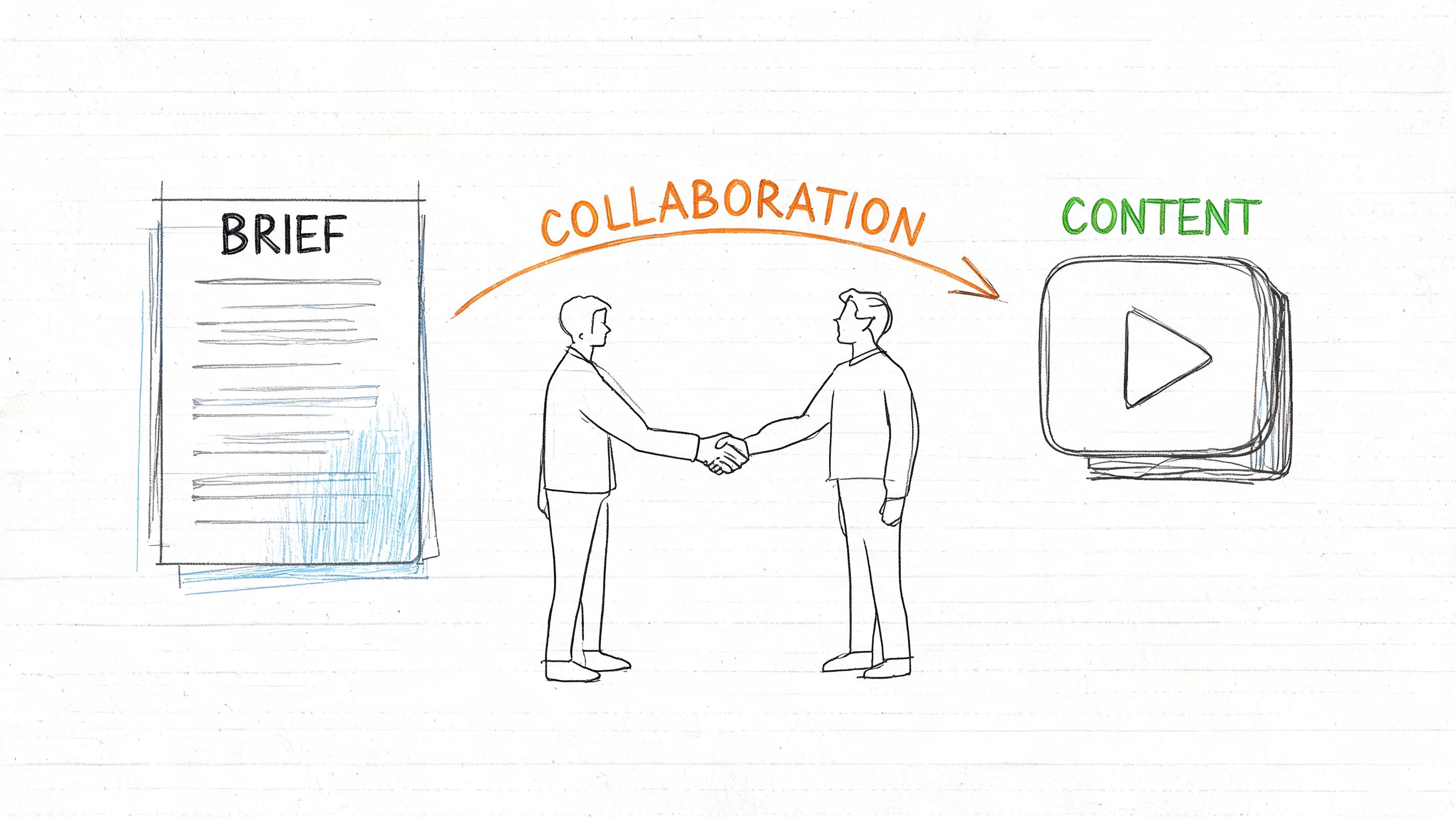
The mistake most brands make is over-controlling the creative. They write the script, prescribe the hook, define the edit, and remove the creator’s own voice. What comes back usually looks compliant, but not persuasive.
A useful brief includes guardrails, not a full performance.
What a strong brief actually needs
Include these components every time:
Campaign objective
Not “raise awareness”. Be specific. Drive bookings, purchases, reviews, traffic, or sign-ups.Audience and angle
Clarify who the content should resonate with and what problem, desire, or moment it should centre on.Deliverables
Spell out platform, format, quantity, draft requirements, and posting window.Mandatory elements
Product naming, venue tagging, offer details, tracking link placement, promo code mention, disclosure requirements.Creative freedom boundaries
What must be included, what must be avoided, and where the creator has room to improvise.Rights and reuse
State whether you can repost organically, use content in paid social, or edit assets into ads.Approval workflow
Define who signs off and by when.
The brief should remove uncertainty, not personality.
Use a repeatable briefing template
A reliable brief often follows this outline:
Brief element | What to include |
|---|---|
Objective | One measurable business outcome |
Product or venue context | What matters, what’s new, what differentiates it |
Audience | The customer profile and relevance cues |
Deliverables | Exact formats and deadlines |
Tracking | Unique link, promo code, landing page |
Compliance | Ad disclosure, claims restrictions, brand safety notes |
Rights | Repost, edit, paid usage, time limits |
Contacts | Who handles approvals and logistics |
This keeps back-and-forth down because it answers the questions creators usually need before production starts.
Protect authenticity while keeping commercial intent
The best-performing creator content usually sounds like the creator, not the brand team pretending to be the creator.
That means giving room on:
opening hook
storytelling structure
filming style
language choices
personal opinion and demonstration
But don’t confuse creative freedom with vagueness. If the tracking code isn’t included, the location tag is wrong, or the CTA is weak, authenticity won’t save the campaign.
A strong operator holds both standards at once. The content needs to feel native to the creator’s audience and still do the commercial job it was commissioned to do.
Implementing a Tech Stack for Bulletproof Attribution
Influencer attribution usually breaks long before reporting. It breaks in setup.
A creator posts with the wrong link. Finance logs payment in one sheet, the campaign manager tracks deliverables in another, and ecommerce pulls revenue from a dashboard that uses different naming rules. By the time someone asks which creator drove sales, the team is stitching screenshots, coupon exports, and half-clean UTMs into a story they cannot defend.
Start with creator-level tracking assets
Every creator needs their own tracking package. Shared links and recycled discount codes make the channel look fuzzy when the actual problem is sloppy instrumentation.
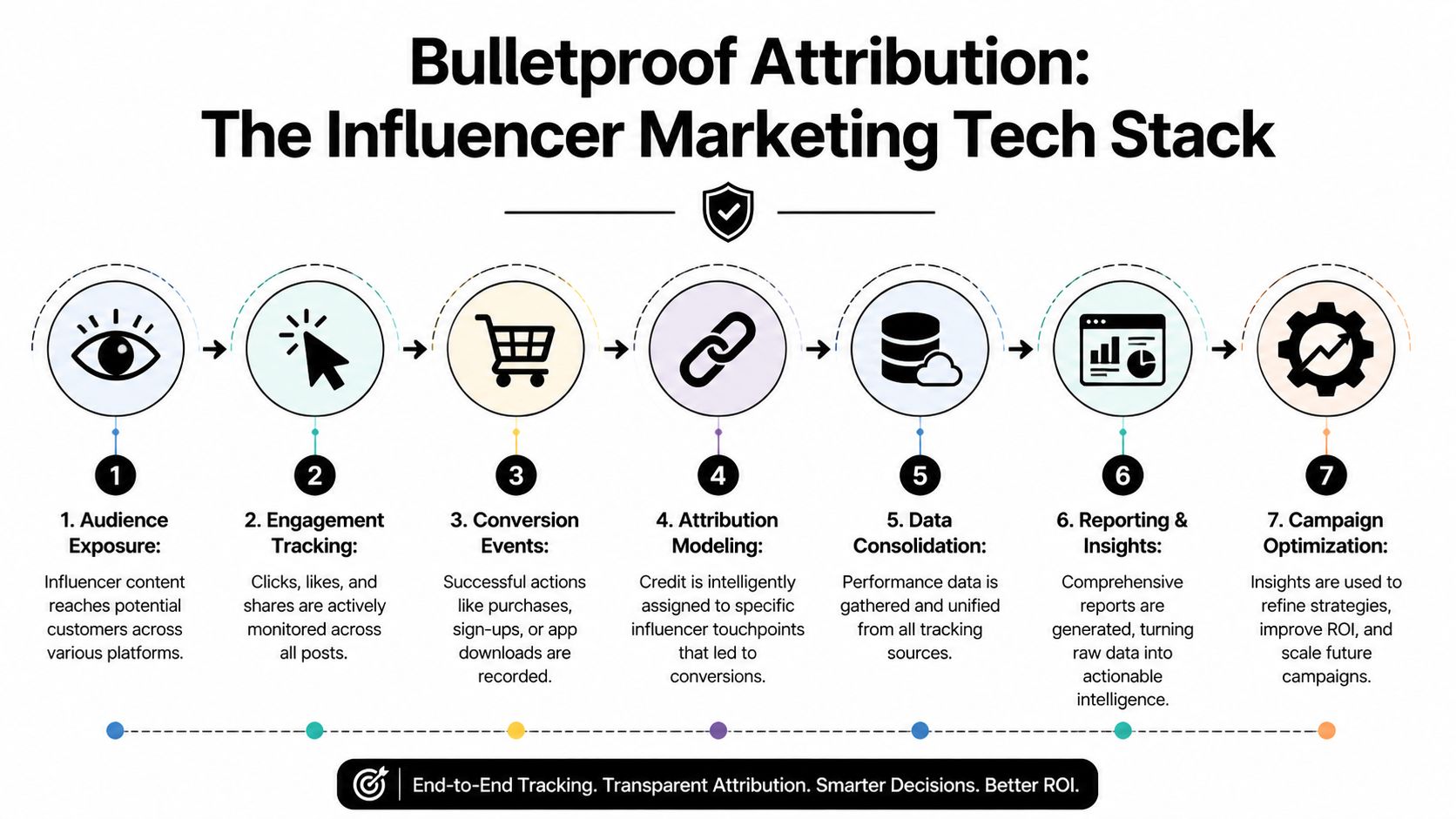
The minimum stack looks like this:
A unique UTM-tagged URL
A unique promo code
A defined landing page
A central record of posting dates and deliverables
A dashboard or reporting layer that combines these signals
That structure gives you usable answers later. Which creator drove qualified traffic but weak conversion? Which one converted through code redemptions with almost no tracked clicks? Which content angle brought in higher-value customers?
Keep UTM naming boring and consistent
Good UTM conventions are plain on purpose. If naming relies on memory, the data degrades within one campaign cycle.
Capture the same fields every time:
platform
creator identifier
campaign name
content type
date or wave
A tagged session should be readable without detective work. I have seen strong creative underperform in reporting because three people used three naming formats for the same campaign. The fix was not better analytics. The fix was one documented schema that everyone followed.
Pair links with codes because customers do not convert in one neat path
Click-based attribution only tells part of the story. Some customers tap a story link and buy straight away. Others watch the content, search the brand later, or remember the code at checkout. For restaurants, salons, and in-store offers, staff may hear the code before the CRM sees the click.
That is why links and codes need to work together.
As noted in LCCA’s UK influencer marketing statistics roundup, brands continue to put real budget into this channel because the upside can be meaningful when tracking is in place. The practical lesson is simple. Spend is not the hard part. Proving return is. If your team needs a clean framework for marketing ROI calculation, build it before the campaign goes live, not after finance asks what the programme delivered.
Build one reporting view people can trust
The right stack is not the one with the most tools. It is the one your team uses every week.
Your reporting view should show, in one place:
live creators
post status
clicks
code redemptions
conversion events
revenue signals
payment status
asset links for content reuse
If a campaign manager has to check Shopify for sales, Google Analytics for sessions, email for deliverables, and a spreadsheet for code usage, attribution will drift. Reporting gets slow. Decisions get delayed. Nobody is confident enough to scale spend.
Some teams piece this together with Airtable, Google Analytics, Shopify, and manual exports. Others use campaign software. Sup is one option in that category. It combines creator sourcing, outreach handling, UTM links, promo codes, campaign dashboards, and a content library in one system.
Here’s a practical explainer on attribution mechanics before you build your stack:
Make attribution part of campaign operations
Tracking fails when it lives with one performance marketer and never makes it into the actual workflow.
The brief, contract, or approval message should state:
the exact link to use
the exact code to mention
where the CTA should appear
whether the creator can pin, save, or reshare
whether the team needs screenshots or direct access after posting
That sounds basic. It is also where plenty of campaigns lose clean attribution. A creator can produce strong content and still break reporting by using an old link from a previous send or forgetting the code in the final frame.
Use the stack to spot patterns, not just prove one sale
Post-level attribution is only the starting point. The ultimate value comes when the system helps you make better buying decisions across multiple campaigns.
Patterns show up fast when the setup is clean:
creators who drive discovery but not efficient conversion
hooks that earn clicks but attract low-quality baskets
local offers that beat national messaging
assets worth repurposing into paid social
creators worth retaining for repeat flights
That is the shift many organizations miss. They treat influencer as a one-off content exercise, then wonder why reporting feels chaotic. A proper system turns it into a repeatable acquisition channel with evidence behind every decision.
Analysing Performance to Optimise and Scale Your Programme
Campaigns rarely fail because the post underperformed in isolation. They fail because teams review influencer activity like a highlight reel instead of an operating system.
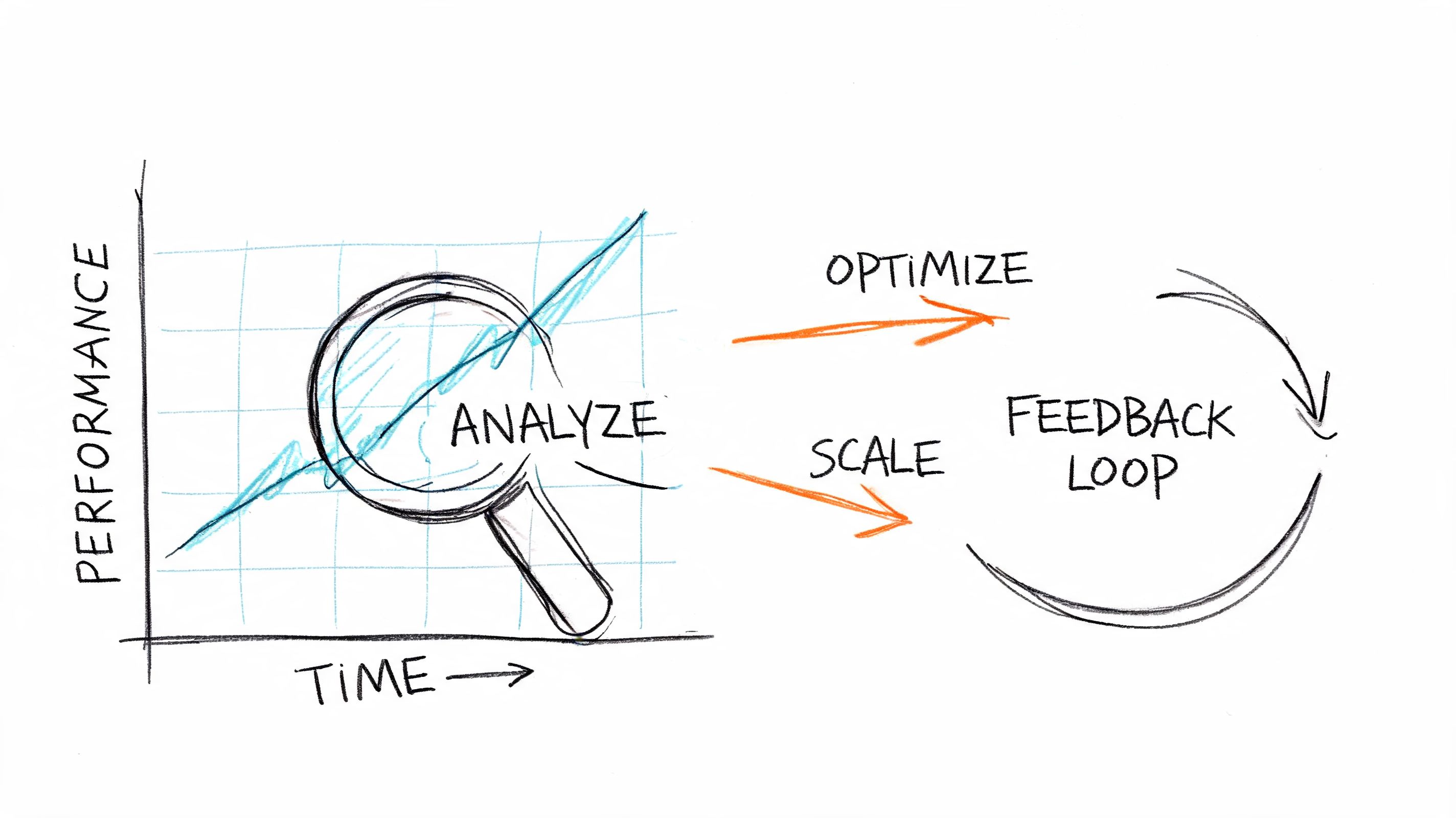
Good analysis answers three separate questions. What happened? Why did it happen? What should change in the next brief, creator mix, offer, or budget split? If the review stops at top-line engagement, the programme stays manual and hard to scale.
Read the funnel in sequence
Review creator performance in the same order a customer experiences the campaign.
Start with attention. Then check action. Then look at commercial outcome. That simple discipline prevents bad calls, like replacing a creator who performed their role when the underlying issue was a weak landing page or an offer that did not convert.
A practical review looks like this:
Funnel stage | What to review | What it can tell you |
|---|---|---|
Attention | Views, reach, watch behaviour, saves, comments | Whether the content earned interest |
Action | Link clicks, landing page visits, code mentions | Whether the offer and CTA created intent |
Outcome | Purchases, bookings, leads, reviews, redemptions | Whether the creator helped drive a commercial result |
Run this review creator by creator, then campaign by campaign. The first level shows who produced results. The second shows what patterns are repeatable across creators, formats, locations, or offers.
Compare creators by role, not just totals
A creator who drives cheap reach is not doing the same job as one who produces strong UGC, high-intent clicks, or assisted conversions over a longer buying window.
That distinction matters.
Local nano creators often outperform larger profiles on trust signals, comment quality, and usable content volume. Larger creators can still earn their keep if they widen the top of funnel and improve branded search, direct traffic, or retargeting performance later. Treating both as if they should hit the same CPA target leads to bad decisions and weaker campaign design.
Good optimisation reallocates. It does not just cut.
Measure relevance, not just output
Audience fit has to show up in reporting, not just in the shortlisting phase.
If the campaign is meant to reach a specific customer segment, the review should break out performance by creator type, audience profile, location, offer, and content angle. Without that structure, teams end up with generic summaries like “strong engagement” or “good awareness,” which are useless when budget gets reviewed.
Diversity is part of that measurement discipline. IQFluence’s review of inclusive creator strategy, which references The Drum’s reporting, makes the broader point that representation affects campaign performance and audience response, not just brand perception. The direct source is here: IQFluence’s diversity in influencer marketing review. Use that kind of insight properly. Define the audience segment in the brief, track performance against it, and compare outcomes by creator mix instead of treating diversity as a soft objective.
Turn winning assets into a reusable library
Every campaign should produce two assets. Clean performance data and content the rest of the team can use.
The strongest operators tag content by creator, product or venue, format, hook, offer, outcome, usage rights, and where it can be reused. That makes post-campaign analysis faster and creative decisions better. Paid social teams get proven hooks to test. CRM teams get credible social proof. Brand teams get examples of content styles that convert without needing another round of guesswork.
If you need a clean framework for tying campaign outcomes back to revenue, this primer on marketing ROI calculation is useful when you’re aligning creator performance with broader budget reviews.
Optimise for repeatability
The key question after a campaign is specific. What should stay the same, and what should change?
Useful answers usually look like this:
keep the creator, change the offer
keep the offer, change the format
keep the format, change the audience segment
keep the asset, repurpose it into paid social
stop using the creator for direct response and use them for UGC or awareness
That is how influencer becomes a scalable channel instead of a sequence of one-off tests. Over time, the programme builds a record of which creator, message, format, and audience combinations produce reliable commercial outcomes. That record is what lets a team scale spend with confidence rather than chasing whichever post looked good this week.
From Manual Task to Strategic Growth Channel
A high-performing influencer marketing campaign doesn’t come from better luck in the creator inbox. It comes from better systems.
That means starting with commercial goals, not handles. It means sourcing creators through a repeatable vetting process rather than impulse shortlists. It means briefing for conversion without crushing authenticity. It means assigning links, codes, and reporting structure before a single post goes live. Then it means reviewing the data closely enough to know what deserves another round of budget.
At this point, many teams either level up or stall.
If influencer stays trapped in DMs, screenshots, and vague recap decks, it remains a time-suck. If it runs through a clear blueprint, structured creator selection, solid attribution, and disciplined optimisation, it becomes one of the most useful growth channels available to consumer brands, hospitality groups, and agencies managing multiple locations or clients.
The channel isn’t broken. The manual way of running it is.
Build the system once. Then improve it campaign by campaign.
If you want to turn influencer from a scattered workflow into a measurable operating channel, Sup helps teams source niche creators, manage outreach, track promo codes and UTM performance, and organise reusable UGC without the usual spreadsheet chaos.

Matt Greenwell
Share