You’re probably doing what most restaurant owners do when bookings wobble. You boost a post, run a few social ads, maybe pay a local creator for a reel, then hope covers improve by the weekend. Some weeks they do. Some weeks they don’t. The main problem isn’t effort. It’s that your advertising for restaurant growth is happening channel by channel instead of as one system.
That’s why spend feels slippery. Search, social, reviews, creators, email, local partnerships. They all affect demand, but they don’t all do the same job. If you treat them as interchangeable, you waste money. If you line them up against how diners decide where to eat, you get more bookings and you can finally see what’s pulling its weight.
Most advice stops at “use Google Ads”, “post on Instagram”, or “work with influencers”. That’s shallow. Restaurants need a framework that connects discovery to footfall, then ties every campaign back to revenue. That matters even more in the UK, where margins are under pressure and every pound has to prove itself.
The Modern Diner's Journey and Your Restaurant's Role
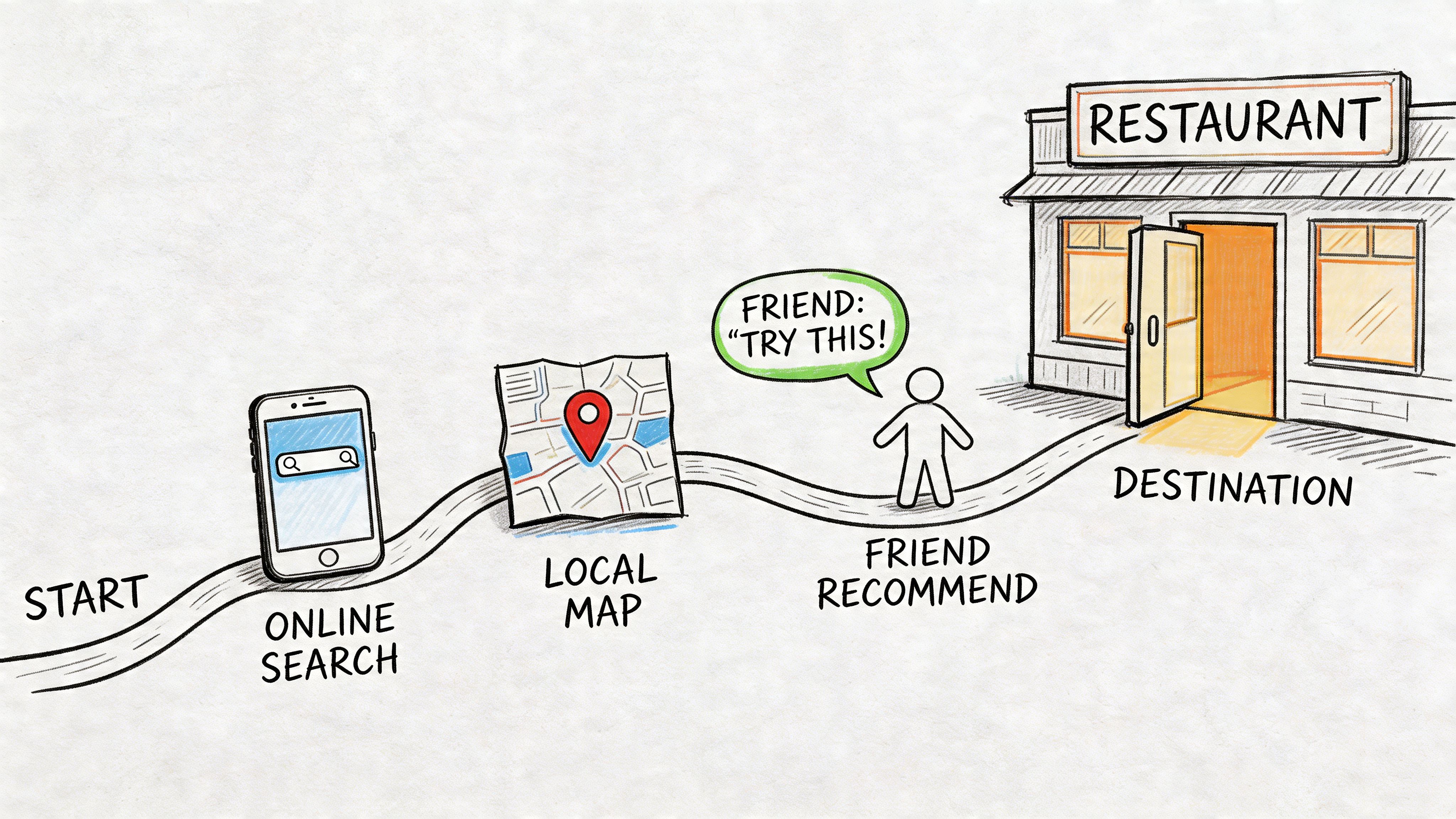
Advertising works better when you stop thinking in channels and start thinking in moments of intent. Diners don’t wake up wanting your Facebook ad. They move through a decision process. Your job is to show up with the right message at the right moment.
A simple way to think about it is the same way people plan a short trip. First they notice a destination. Then they check whether it’s worth going. Then they book. If the experience is good, they go again and tell someone else.
The four stages that matter
Here’s the practical version for restaurants:
Discovery Someone thinks, “What’s good nearby?” or “Where should we go this Saturday?” At this stage, local search, TikTok, Instagram, maps, creator content, and word of mouth matter.
Consideration
They’ve found you, but they’re checking whether you’re worth their money. They look at reviews, menu, photos, prices, opening hours, and whether the room feels right for the occasion.Decision
This is the make-or-break point. Can they book fast? Is the menu easy to find? Are directions obvious? Can they claim an offer or reason to act now?Loyalty
This is where profit compounds. A first visit is expensive to win. A repeat visit is cheaper, easier, and usually more valuable. Loyalty also fuels referrals, reviews, and user-generated content.
Practical rule: If you can’t say which stage an advert is meant to influence, don’t run it.
Match the channel to the stage
Most wasted ad spend comes from mismatch. Owners use a top-of-funnel channel and expect direct bookings tomorrow. Or they spend on conversion ads while their reviews and photos are weak, so people click and then leave.
Use this working model:
Journey stage | What the diner needs | Best-fit advertising |
|---|---|---|
Discovery | Awareness and intrigue | Google Business Profile visibility, local social ads, creator content |
Consideration | Proof and reassurance | Reviews, menu pages, strong photos, local SEO copy |
Decision | Low friction and urgency | Booking ads, click-to-call, trackable offers, remarketing |
Loyalty | A reason to return | Email, SMS, community events, referral prompts |
This is also why guest experience tools belong in your marketing plan. If you collect first-party data in venue, you can turn one visit into a second and third. Purple’s guide on Restaurant Wifi: Benefits and Strategies to Drive Revenue is useful if you want a practical view of how in-venue WiFi can support data capture and repeat visits without making the guest experience clunky.
What owners should do first
Before spending more, audit your current activity against the journey:
List every active marketing channel you’re using now.
Assign each one to a stage. If a tactic doesn’t clearly fit, it’s probably random activity.
Find the broken handoff. Many restaurants generate awareness but lose the booking because the menu is outdated, reviews are unanswered, or the reservation flow is awkward.
Fix the weak stage before adding another channel.
That’s how advertising for restaurant growth stops being a patchwork and starts behaving like a machine.
Mastering Your Digital Front Door with Local Search
For most restaurants, the most valuable advertising isn’t flashy. It’s being the obvious answer when someone nearby is ready to eat. Local search captures demand that already exists. That means it usually beats broad awareness campaigns for efficiency.
Your Google Business Profile is the front door. If it’s incomplete, inconsistent, or neglected, you’re making hungry people work too hard.
Fix your Google Business Profile first
This takes less time than most owners think, and the payoff is immediate because it affects maps, branded searches, and “near me” intent.
Use this checklist:
Choose the most accurate primary category
Don’t get clever. If you’re a pizza restaurant, say that. If you’re a brunch spot, reflect that accurately. Relevance beats creativity here.Write a useful business description Include what you serve, who it’s for, and where you are. Keep it natural. Mention terms diners search for, such as neighbourhood, cuisine, and dining occasion.
Upload photos that sell the experience
Prioritise food, frontage, interior atmosphere, drinks, and real guest settings. A moody dining room shot might look elegant, but diners still need to see what the place feels like at service.Keep practical details exact
Opening hours, booking link, phone number, menu, accessibility info, and service options need to be current. Wrong details kill trust fast.Answer reviews consistently
Don’t just thank positive reviewers. Respond to criticism calmly, fix what you can, and show future diners that you pay attention.
Your profile isn’t a listing. It’s a conversion asset.
Use local SEO like a restaurant operator, not an SEO agency
You don’t need to become an SEO specialist. You need to cover the basics that influence local intent.
Start with the phrases your customers already use. Think like a diner, not like your brand deck. “Best Italian near me”, “Sunday roast in Leeds”, “family-friendly brunch in Manchester”, “cocktails and small plates Shoreditch”. Those are decision phrases.
Then place those ideas where they belong:
On your website homepage with location and cuisine clearly stated
On key landing pages for brunch, private dining, takeaway, or seasonal menus
Inside image alt text and photo file names where practical
In your Google Business Profile posts and updates
On menu and booking pages so users and search engines both understand the offer
A lot of operators miss the overlap between creator content and local visibility. This breakdown of how influencer marketing impacts restaurant SEO and local search is worth reading because it connects social mentions, local intent, and search presence in a way most restaurant guides ignore.
The under-an-hour local search tune-up
If your day is already overloaded, do these in order:
Check your Google Business Profile from a customer’s phone
Replace weak photos with stronger, current ones
Update your description with cuisine, location, and occasion keywords
Make sure your menu link works
Test your booking path from search to confirmation
Reply to recent reviews
Check that your website homepage states what you are and where you are in plain English
What good local search should feel like
Not complicated. Just obvious.
A diner should be able to search, find you, trust you, and book in a few taps. If your local search presence creates friction, no amount of social creativity will compensate for it. Nail this first, because it catches the highest-intent traffic you’ll ever get.
Driving Demand with Social Media and Influencer Marketing
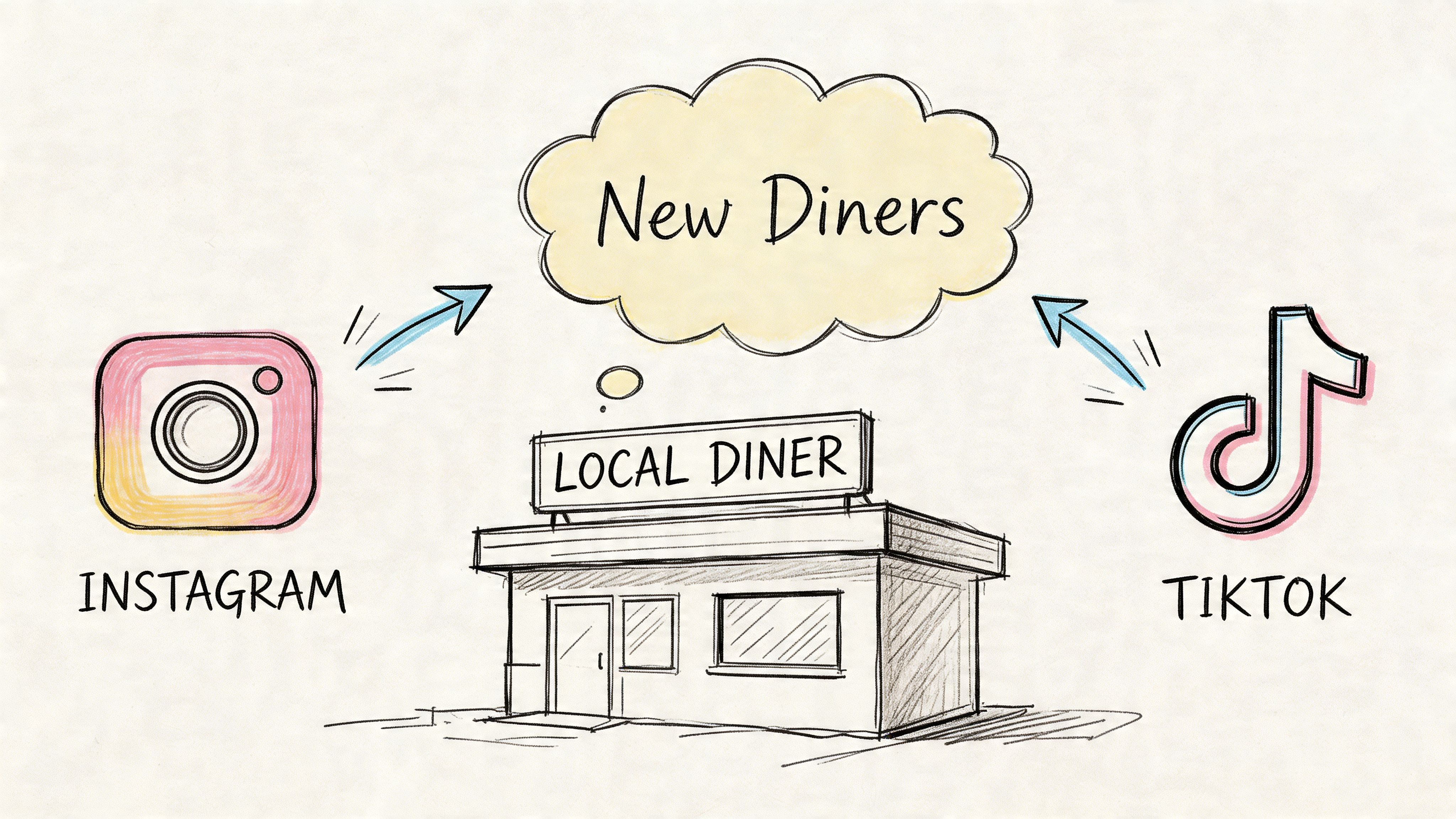
Local search catches people who already want somewhere to eat. Social media creates the want. That’s the difference.
If you run paid social properly, you can keep your restaurant in front of people before they decide where to go. If you run influencer and UGC campaigns properly, you add trust, relevance, and local proof that standard ads rarely match.
Paid social and creator campaigns do different jobs
Don’t lump them together. They solve different problems.
Channel | What it does well | Where it falls short |
|---|---|---|
Paid social ads | Fast reach, postcode targeting, offer promotion, remarketing | Often ignored if the creative feels like an advert |
Influencer marketing | Trust, local relevance, social proof, usable UGC | Harder to manage and measure if you do it manually |
Paid social is useful when you need controlled delivery. New opening. Midweek lull. Lunch push. Event night. You can target by geography, age, interests, and timing, then direct people to book or claim an offer.
Influencer content works differently. A local food creator shows your restaurant in context. The audience sees a real person choosing your venue, reacting to the dishes, and signalling that the place is worth trying. For hospitality, that social proof matters because people don’t just buy food. They buy an evening, a mood, and a safe choice for their friends.
What to run on paid social
Restaurants usually overcomplicate creative. Keep it simple and use formats that match the goal.
Awareness ads
Short videos of signature dishes, room atmosphere, or chef moments. These should sell feeling, not features.Offer ads
Use these for quieter periods. Midweek set menu, early evening drinks, brunch launch, or event tie-in.Retargeting ads
Show ads to people who visited your website, clicked to the menu, or engaged with your content but didn’t book.Event-specific ads
Good for live music, tasting menus, seasonal activations, and private dining pushes.
A common mistake is targeting too broadly. Restaurants don’t need vanity reach. They need nearby, relevant attention.
Why local creators punch above their size
Micro and nano creators are often more useful than larger names for restaurants because they feel local and believable. Their audiences are smaller, but the fit is tighter.
That matters a lot for chains and franchises. The challenge isn’t finding “an influencer”. It’s finding the right creator for each site, in each catchment, without your team drowning in outreach. There are 3,200+ UK multi-site operators, and scaling local marketing across regions is a real operational problem. Queries like “TikTok creators by postcode for restaurants” are up 45% YoY, while AI-matched local creators drove 28% higher engagement in Manchester pilots, according to Influencer Marketing Hub. That tells you two things. Demand for hyper-local creator matching is rising, and manual outreach doesn’t scale cleanly.
Broad reach looks good in a report. Hyper-local relevance fills tables.
Where manual influencer outreach breaks
Owners often start with DMs. That’s fine for one-off tests. It falls apart fast when you need consistency.
Manual outreach creates the same set of problems every time:
Sourcing takes too long
Someone on your team scrolls Instagram or TikTok, guesses who’s local, then starts messaging.Vetting is inconsistent
Followers don’t tell you if the creator influences nearby diners or fits your brand.Communication drags on
Negotiation, briefing, booking, reminders, content approvals, and follow-ups eat time.Tracking is messy
Without unique links or codes, you get views and likes but no clean tie to covers or revenue.
If you’re running one location and one creator test, you can manage that by hand. If you’ve got multiple sites, campaigns, or seasonal pushes, you need a process.
For a practical operating model, this guide on how to run a restaurant influencer campaign step by step gives a grounded workflow rather than generic “find creators and collaborate” advice.
A quick visual example helps here:
What to insist on in every creator campaign
If you want results, don’t brief vaguely. Set terms clearly.
Define the business goal
Footfall, lunch covers, brunch awareness, reviews, takeaway orders, or private dining leads. Pick one primary goal.Specify the audience catchment
Local means local. A creator can be excellent and still wrong for your postcode.Request usable content formats
Short-form video, stills, story frames, and permission to reuse the content in ads if agreed.Build in a tracking method
Every creator should have a unique code, link, or booking path. If they don’t, you’re guessing.Review outputs against business fit
Pretty content isn’t enough. The content has to make the venue look bookable, desirable, and easy to choose.
One platform-built option in this space is Sup, which combines AI matching with a managed workflow to source local micro and nano creators, handle outreach, and assign unique promo codes and UTM links for attribution. For chains or operators running repeated local campaigns, that kind of setup reduces spreadsheet chaos and gives marketing teams a cleaner operating model.
The right split for most restaurants
Use paid social for reach and controlled promotion. Use creators for trust and local proof. Reuse the best creator content inside your paid ads. That combination is stronger than either tactic on its own.
That’s the version of advertising for restaurant growth that compounds. One channel introduces you. The other makes you believable.
Building Your Community with Email SMS and Partnerships
The first booking gets attention. The second booking builds the business.
Most restaurants underuse their own channels. Social platforms can change reach overnight. Search rankings move. Creator campaigns fluctuate. Your email list, SMS list, and local partner network are different because you control them.
Build a list that belongs to you
Start simple. Capture first-party data through your booking system, WiFi sign-up, QR codes in venue, event registrations, and feedback forms. Don’t overbuild this. You just need a steady, legitimate way to collect permission-based contact details.
Then send messages people might want:
Menu and launch updates
New dishes, seasonal drinks, chef collaborations, special menusOccasion-based invites
Mother’s Day, Valentine’s, New Year’s Eve, tasting nights, live eventsInsider access
Early booking windows, limited seat announcements, soft launchesUseful local content
Not every send needs to be a discount. Community relevance often outperforms constant offers.
If you want a practical reference point for structuring better campaigns, Mailtani’s guide to effective email marketing is a useful read because it focuses on execution rather than vague theory.
The most profitable message usually isn’t “10% off”. It’s “Your table is waiting for a reason that feels worth leaving home for.”
Use SMS carefully and only where speed matters
SMS works best when timing matters. Last-minute availability. event reminders. limited covers. weather-based offers for terraces or Sunday roast pushes.
Don’t turn it into a spam channel. Email can carry story and detail. SMS should carry urgency and action. Keep it brief, clear, and tied to something time-sensitive.
Local partnerships beat isolated promotion
A lot of restaurants think partnerships are separate from advertising. They aren’t. Good partnerships reduce customer acquisition cost because another trusted local brand introduces you to the right people.
The best ones are practical:
Partner type | What to do together | Why it works |
|---|---|---|
Nearby offices | Staff offers, lunch packages, team socials | Brings recurring weekday demand |
Hotels | Guest recommendations, welcome offers | Captures visitors with immediate intent |
Local retailers | Co-hosted events, reciprocal promotion | Shares audience trust |
Community groups | Book clubs, tastings, meet-ups | Turns your venue into a habit, not a one-off |
Community is the retention engine
Email, SMS, and partnerships work better together than separately.
A guest visits because a local creator posted about you. They join your list through a booking or in-venue prompt. You invite them back for a seasonal menu. A nearby bookshop or office promotes a shared event. They return with friends. That’s community-driven advertising for restaurant growth. It’s quieter than flashy campaigns, but it’s usually more durable.
If your restaurant feels like part of local life, you won’t need to discount your way into relevance.
Planning and Budgeting Your Restaurant Advertising Strategy
Most restaurant budgets aren’t really budgets. They’re reactions. Sales dip, so someone boosts posts. A competitor opens, so you run ads. Christmas is coming, so you throw money at whatever feels urgent.
That’s not strategy. It’s leakage.
Use a simple allocation model
You don’t need a complicated media plan. You need a repeatable split that protects proven channels while leaving room to test new ones.
A practical model is 70/20/10:
70 percent on proven demand capture
Local search, Google Business Profile maintenance, branded search support, remarketing, and the channels that already bring high-intent traffic.20 percent on growth channels
Creator campaigns, paid social for awareness, and structured local activations that can create new demand.10 percent on experiments
New event formats, new audience tests, partnership pilots, new creative angles.
That model forces discipline. It stops you from starving what works while still giving you space to find the next win.
Budget around business problems, not platforms
Don’t start with “How much should we spend on Instagram?” Start with “What commercial problem are we solving?”
Examples:
Empty Tuesday evenings
Weak lunch trade
Poor awareness in a new catchment
Low repeat visit rate
Need for more private dining enquiries
Each problem points to a different mix of channels. Midweek covers might need local paid social plus SMS. New site awareness might need search readiness plus local creators. Weak repeat visits might need stronger CRM and partnerships, not more top-of-funnel spend.
Spend follows the bottleneck. Not the trend.
Set goals that a manager can act on
Use a simple SMART filter. Specific, measurable, achievable, relevant, and time-bound. Keep it commercial.
Here’s a clean planning template:
Campaign element | Example |
|---|---|
Objective | Increase midweek dinner bookings |
Audience | Local diners within the catchment area |
Offer or message | Set menu, occasion-driven creative, or limited booking window |
Channel mix | Local search, paid social, creator content, email |
Measurement | Bookings, code redemptions, footfall, revenue |
Timeframe | A defined month or quarter |
Avoid vague goals like “increase awareness”. If awareness is the goal, define the commercial next step that awareness is meant to support.
Review budget monthly, not emotionally
Restaurant demand shifts fast. Weather, seasonality, local events, school holidays, and staffing all affect performance. That doesn’t mean you should rewrite the whole plan every week.
Review monthly. Ask:
Which channels brought measurable demand?
Where did we create interest but fail to convert?
What should get more budget next month?
What should be cut, paused, or rebuilt?
That discipline matters more than getting the perfect number on day one. A workable plan beats a clever one that nobody follows.
Measuring What Matters From Footfall to Financial ROI
If you can’t tie advertising to bookings, covers, and revenue, you don’t have a marketing engine. You have activity.
A lot of restaurant owners think measurement is only for big chains with data teams. Wrong. Small operators need cleaner attribution even more because margin for error is tighter. The aim isn’t to track everything. It’s to track the few signals that tell you whether spend is turning into money.
Start with channel-appropriate metrics
Not every channel should be judged by the same yardstick.
Use this as a baseline:
Local search
Calls, direction requests, menu views, website clicks, booking completionsPaid social
Reach, click-throughs, landing page visits, booking starts, offer claimsEmail and SMS
Opens, clicks, redemptions, repeat bookings, event fill rateInfluencer campaigns
Views and engagement matter, but they are not enough. You need creator-level clicks, code usage, bookings, and revenue.
That last point is where most restaurant reporting falls apart. Teams celebrate a reel with strong comments, then can’t prove whether it brought anyone through the door.
Why influencer ROI is the sticking point
This is the part most generic marketing guides dodge. In the UK restaurant market, creator campaigns often fail at the reporting stage, not the content stage.
Amid 7.5% hospitality inflation in 2025, proving ROI is critical. Yet 68% of UK restaurants cite poor attribution as a barrier to scaling creator collaborations. One reason is behavioural. 42% of London diners aged 18 to 34 discover eateries via TikTok, but only 15% convert without trackable incentives, leaving average influencer ROI at 1.8x versus 3.2x for attributed Google Ads, as noted in Forbes.
That gap doesn’t mean influencer marketing is weak. It means restaurant operators often can’t track it properly.
The fix is boring and effective
Attribution improves when you stop relying on screenshots, anecdotal comments, and “we were busy that weekend”.
Use a direct tracking structure:
Assign each creator a unique promo code
This ties in-venue redemption or online ordering back to the individual campaign.Use unique UTM links
That shows who drove clicks, sessions, and conversions on your booking or menu pages.Create dedicated landing paths where possible
Keep the journey tight. Fewer steps means cleaner data.Track by creator, location, and campaign objective
One report for “influencers” is too broad to act on.Review financial outcomes, not just media metrics
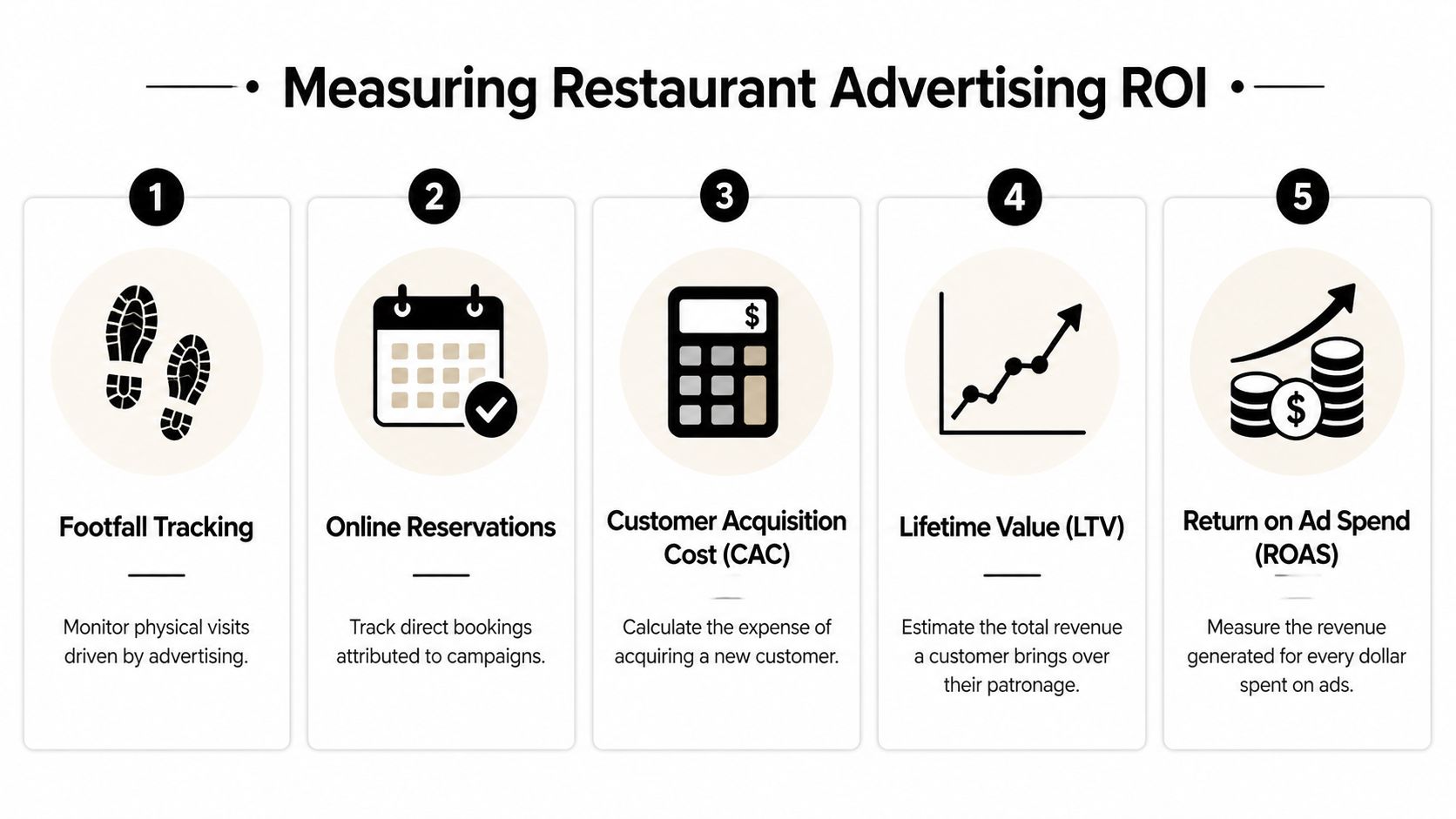
Revenue, average booking value, customer acquisition cost, and repeat behaviour matter more than likes.
A lot of confusion comes from mixing up return metrics. If your team needs a quick refresher, this explanation of understanding the nuances of ROI vs. ROAS is helpful because it separates ad revenue return from the broader profitability picture.
Good attribution doesn’t make a weak campaign strong. It tells you which strong campaigns deserve more budget.
Use dashboards so the team can actually respond
The main reason attribution breaks is operational. Someone has to build links, create codes, collect creator posts, reconcile redemptions, and report outcomes. Done manually, that becomes a spreadsheet problem no one wants to own.
That’s why purpose-built tracking setups matter. If you’re evaluating performance frameworks for creators, this guide on how to measure influencer marketing with the metrics that actually matter is a strong reference because it keeps measurement tied to commercial outcomes.
For restaurants using creator campaigns regularly, a central dashboard is usually the difference between scalable activity and chaos. It should show, in one place, which creator posted what, what link or code was used, how many clicks followed, how many redemptions happened, and what revenue was associated with them. Without that, you’ll keep underinvesting in channels that may be working and overinvesting in channels that merely look tidy on paper.
The same logic applies across all advertising for restaurant growth. Track what each channel is meant to influence, then connect it to money. Footfall. Bookings. Redemptions. Revenue. Repeat visits. If a campaign can’t be measured against a business outcome, tighten it until it can.
If you want a cleaner way to run creator campaigns without chasing DMs, spreadsheets, and manual attribution, Sup gives restaurants a done-with-you workflow for sourcing local creators, launching campaigns, and tracking clicks, code redemptions, bookings, and revenue in one place.

Matt Greenwell
Share